
Nothing in Basket!
What's Happening in Christina's Suffolk Garden: August 2026
Surviving heatwaves, harvesting seeds, and observing wildlife in our dry East Anglian small garden.
- Location: Mildenhall, Suffolk
- Conditions: Extended heatwaves, drought, poor sandy soil
- Garden Stars: Buddleja, Gaura, Penstemons, Lavender, Erigeron, and Drought-Tolerant Mix
- Wildlife Visitors: Hummingbird hawk-moths, Emperor dragonflies, bats, and juvenile songbirds
3rd August: Into the Fourth Heatwave
Even drier and hotter than in previous years, gardening this summer feels like a constant, uphill battle to keep young plants alive. Today marks the second day of an official third heatwave for 2026, with temperatures pushing well past 30°C. Inside a walled garden, that heat is magnified significantly.
In truth, our Suffolk garden has been baking in relentless sun with virtually no rain since early June. There are days when stepping outside feels almost painful. Yet, there is a smaller silver lining to being forced indoors: a true wildlife garden often benefits from being left entirely alone to get on with things.
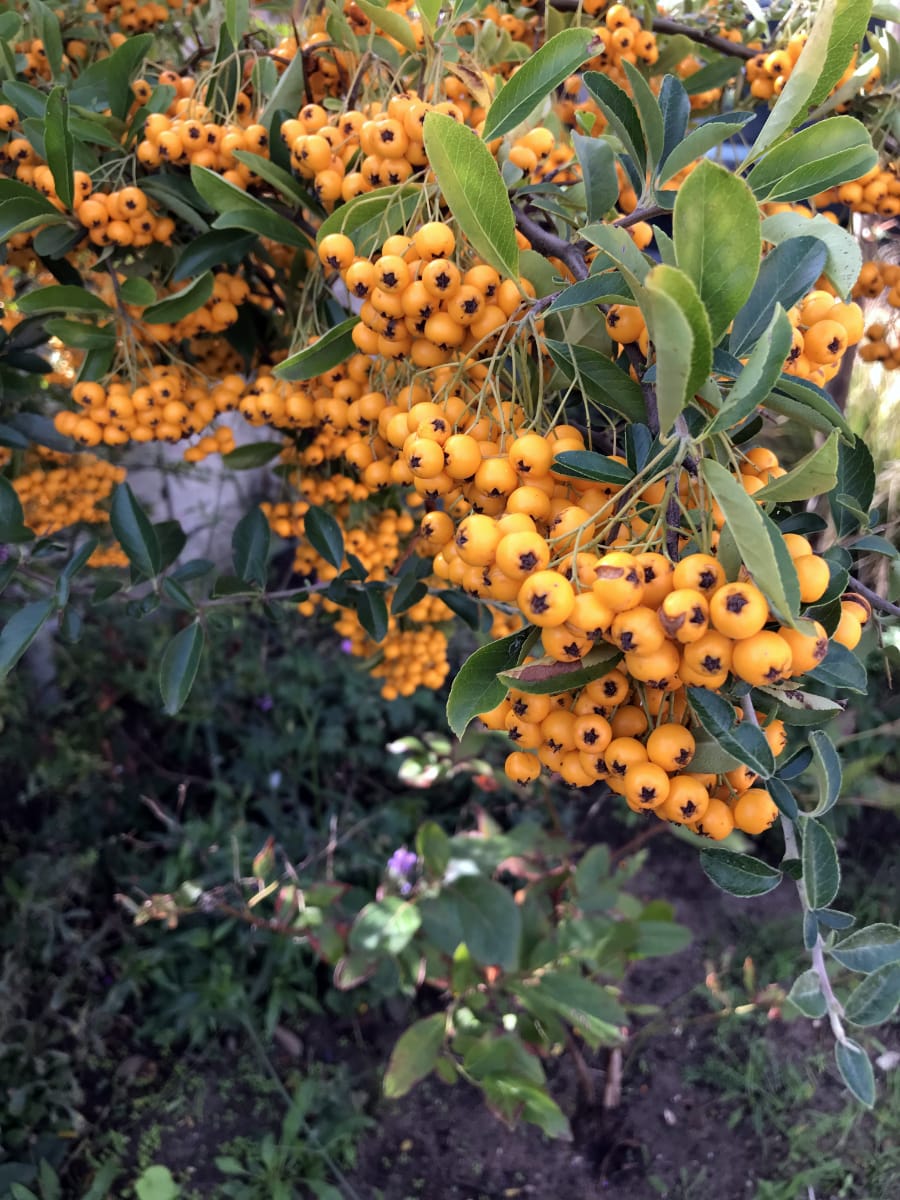
The severe conditions are certainly taking their toll on our newest additions. Young specimens, including a magnolia, an apple tree, and a newly planted pyracantha hedge, are dropping leaves and crisping to brown. Even my oldest Photinia ('Red Robin') is showing the strain, its brilliant red foliage turning papery and dry.
- Relentless 30°C Heat = High evaporation and soil baking.
- Human Intervention Paused = Natural ecosystem self-regulates; wildlife settles in.
The Grass Retreat & The Shade Deficit
By mid-August, our lawn has surrendered entirely. It is now a flat, carpet-like expanse of straw, with large patches dying off completely to reveal the raw sandy earth beneath. This is an annual challenge in our light Suffolk soil, but the prolonged dry spells are accelerating the damage year after year, allowing tough, invasive weeds to take hold.
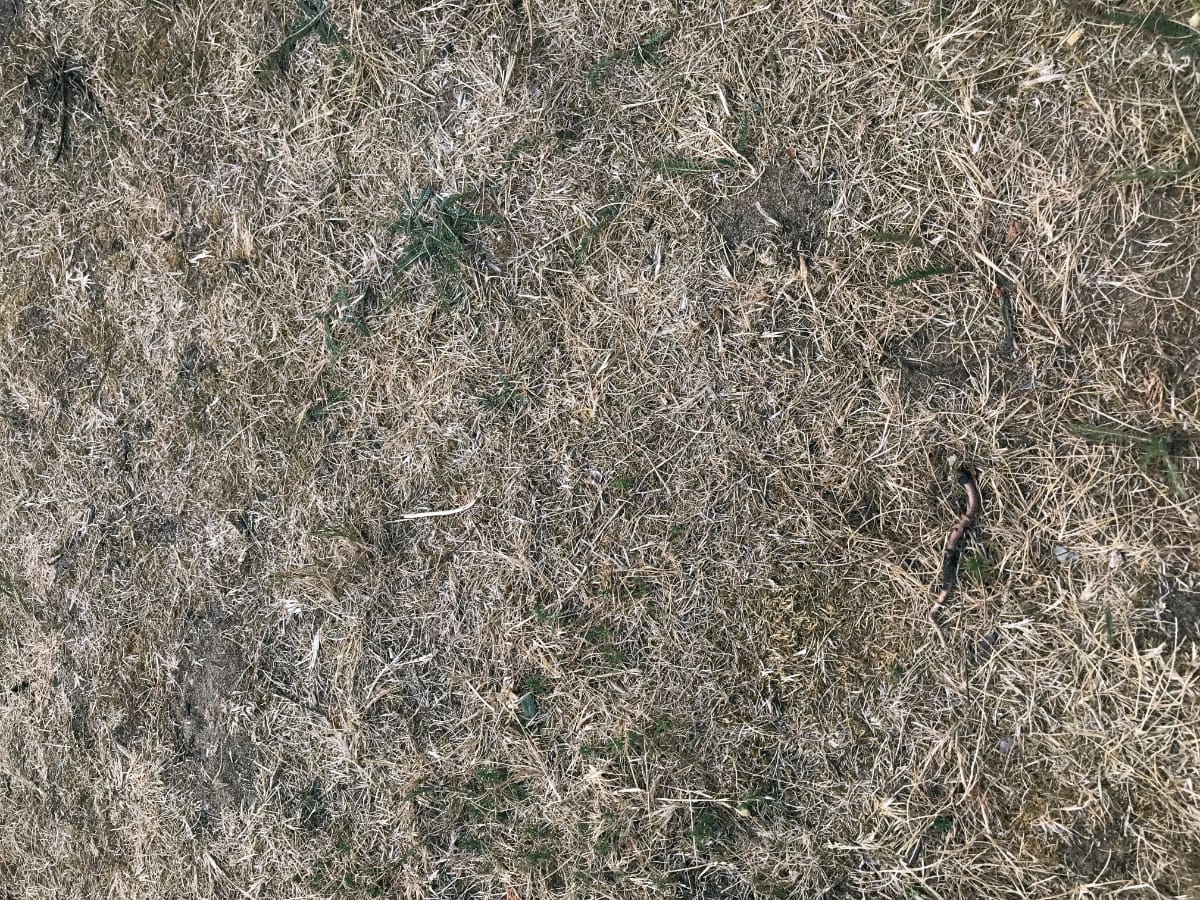
We are fast approaching the decision to abandon grass altogether, replacing it with ornamental grasses and expansive dry-flower beds.
Our shade options are currently limited. A few years ago, neighbouring properties removed several mature trees right along our boundary out of concern for potential root damage, stripping away our natural canopy. Additionally, when we moved into this house eleven years ago, we planted Cherry Laurels for privacy. Over time, I discovered that nothing would grow beneath them, and because I suffered an allergic reaction to them every time I went near them, they had to be removed. Which we completed in October 2025.
We have planted new trees, but while we wait for them to mature, we are looking into short-term structures, such as an arbour or two, just to create essential pockets of shade for ourselves and shade-loving plants. Because it's impossible to spend any time in the garden in this heat. My body is changing with the climate, once I was only just comfortable being out in 23c, now I'm up to 26c.
A Haven for Pollinators and Winged Visitors
Despite the scorched conditions, the garden is buzzing with extraordinary activity. Butterflies have arrived in force, and for several weeks now, we have had at least five Hummingbird Hawk-moths (Macroglossum stellatarum) actively feeding in the garden all day long.
Earlier in the spring, Peacock butterflies dominated the borders; now, Red Admirals have taken centre stage. While overall butterfly numbers are lower than in previous years, we are seeing steady visits from Large and Small Whites, alongside occasional Painted Ladies, Small Tortoiseshells, Comma, Meadow Brown and one Holly Blue. Numbers of Meadow Browns, Orange-tips, Holly Blues have been sparse, we usually see lots of these at the beginning of the year. But day-flying moths are thriving on our Buddleja, Salvia, verbena bonariensis, and Red Valerian. I was also thrilled to spot a delicate Small Copper flitting through the growth.
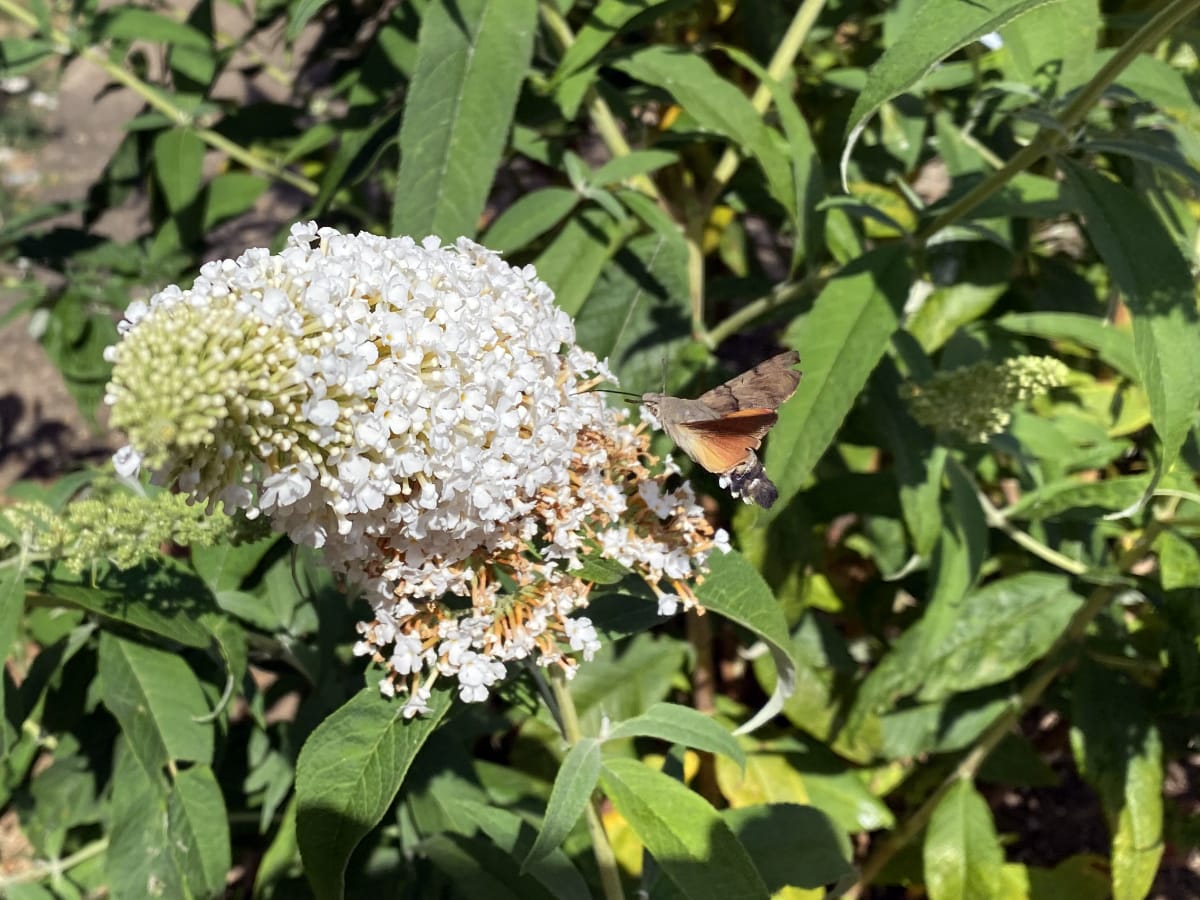
When walking through the garden, I try to keep my distance, observing them through binoculars. Surprisingly, the hummingbird hawk-moths have grown so bold they frequently cut right across my path to reach a juicy Buddleja flower head! The butterflies don't seem to mind my presence either, provided I don't cast a shadow over them, though neither species appreciates an iPhone getting too close for a photograph.
As I step across the straw-like grass, hundreds of grasshoppers and crickets leap out of the way. I have never seen such a dense population; the sustained heatwave has clearly triggered a population boom.
Dragonflies, Bats, and Birds of Prey
Insect predators are out in abundance. This morning, I enjoyed watching a magnificent Emperor Dragonfly (Anax imperator), the largest dragonfly species in the UK. It rested calmly on the Buddleja leaves before taking off to patrol our small pond.
- Buddleja & Dry Perennials = Nectar source for Moths & Butterflies.
- Insect Clusters = Hunting grounds for Emperor Dragonflies & Birds.
At twilight, it has been wonderful to see our local bat population. For the first time, instead of merely circling the outer perimeter of the property, they are dipping low and swooping directly through the centre of the garden.
Up above, while Buzzards are a regular sight circling on the thermals, this is the first year we have noticed Red Kites actively inspecting our garden, alongside hunting Kestrels and Sparrowhawks.
Adjusting Bird Feeding Habits
Following advice from the RSPB, we stopped putting out supplementary bird food for the summer months. The knock-on effect has been fascinating: we have far fewer territorial squabbles and much less noise over feeder access. The garden feels noticeably more harmonious, left to the resident families who own the space; our Blackbirds, Robins, Wrens, Dunnocks, and Goldcrests.
Small flocks of Blue, Great, Long-tailed, and Coal Tits still sweep through three times a day. They stop for a quick splash in the water baths before stripping the borders of natural food sources like berries, aphids and bugs. The Collard Doves have abandoned us, but we still get a few woodpigeons enjoying the water baths.
It has been a particularly successful breeding season for Blackbirds; we have three juveniles from the same brood exploring the borders, alongside several young Robins at various stages of fledging, plus a magpie and a Woodpigeon who are still relentlessly harassing their parents for food!
Seed Harvesting: The Drought-Tolerant Mix
Even the Blue Flax (Linum perenne) from my Drought-Tolerant Seed Mix has finished its main flowering flush and set seed. I have been collecting the seed pods manually, a quiet, rhythmic task I find immensely therapeutic. On breezy days, I let the wind help me winnow the harvest; on calm days, I collect the seed heads in a bowl and blow gently across them to separate the heavy seeds from the light chaff.
Originating from the dry slopes of the Rocky Mountains, Blue Flax possesses a deep taproot that makes it totally indifferent to heatwaves or temporary summer droughts. It has flowered continuously since May, and new buds are still pushing through.
Whenever I am out in the front garden harvesting and end up chatting with a passing neighbour, I love sharing freshly picked seeds. Today, I spent a lovely morning catching up with a neighbour about life and the universe while picking the flax seed heads. She has long admired its delicate blue petals and also loves my cornflower display, so I was more than happy to hand her a fresh batch of seeds (free of charge) to try in her own garden.
Lessons in Front Garden Boundaries
Sharing seeds voluntarily is one of the great pleasures of gardening, but boundary control can sometimes be a challenge!
Earlier this year, a local visitor decided our front display was public property, coming by daily to pick large handfuls of blooms until the stems were stripped bare. She was even teaching her two-year-old how to pick them, until she caught sight of our security camera, quickly ducking behind a Buddleja, and informing her child they were on camera! We haven't seen her since.
To prevent a repeat performance, we have planted a defensive pyracantha hedge along the boundary. Future flower displays will be positioned closer to the house, safely out of reach from the public footpath
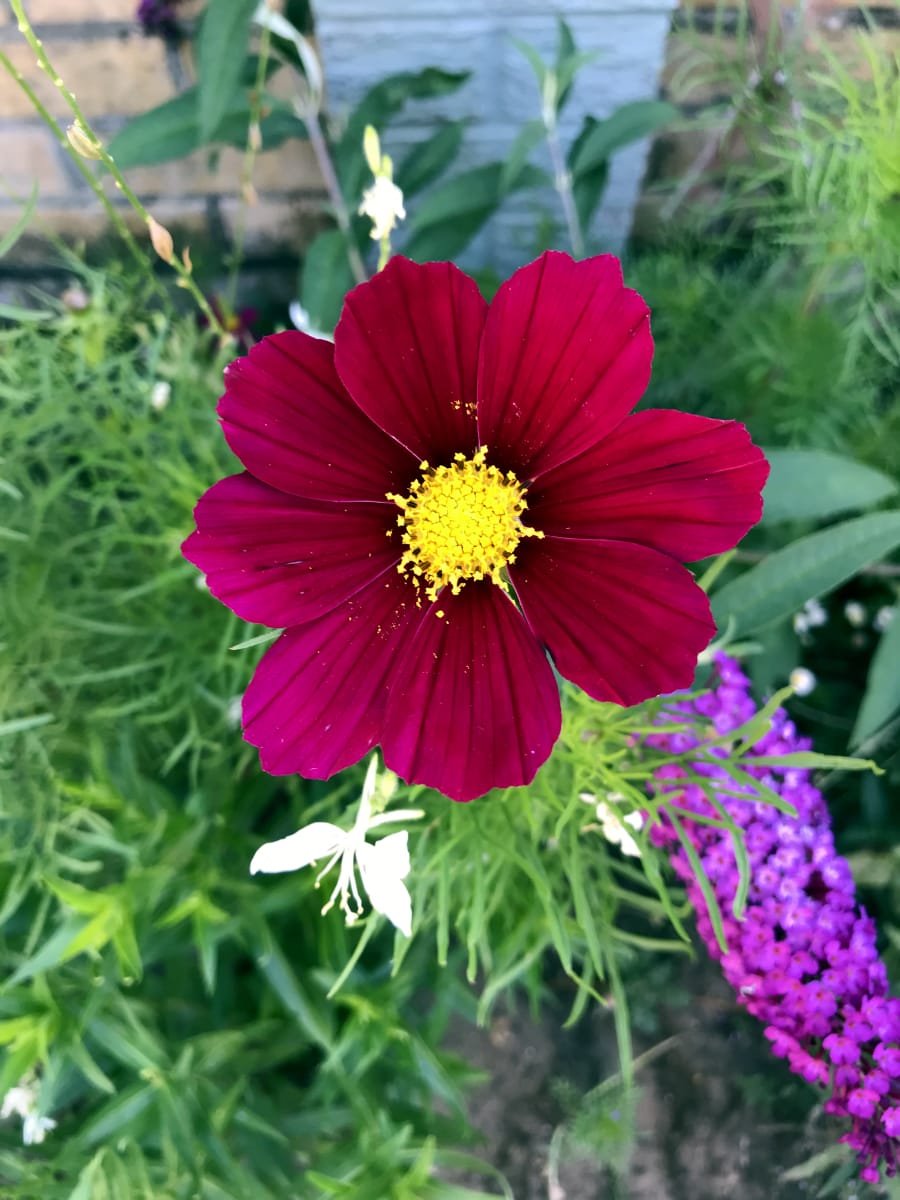
All of our cosmos were casulties when the visitor picked them from our front garden borders.
Self-Built Bee Hotels and Snail Busters
Our DIY bee hotels, constructed using scrap wood, old garden bench legs, and hollow bamboo canes, have been a resounding success. We mounted them along the house wall and the main garden boundary wall, which happen to be the two warmest, sunniest spots on the property.
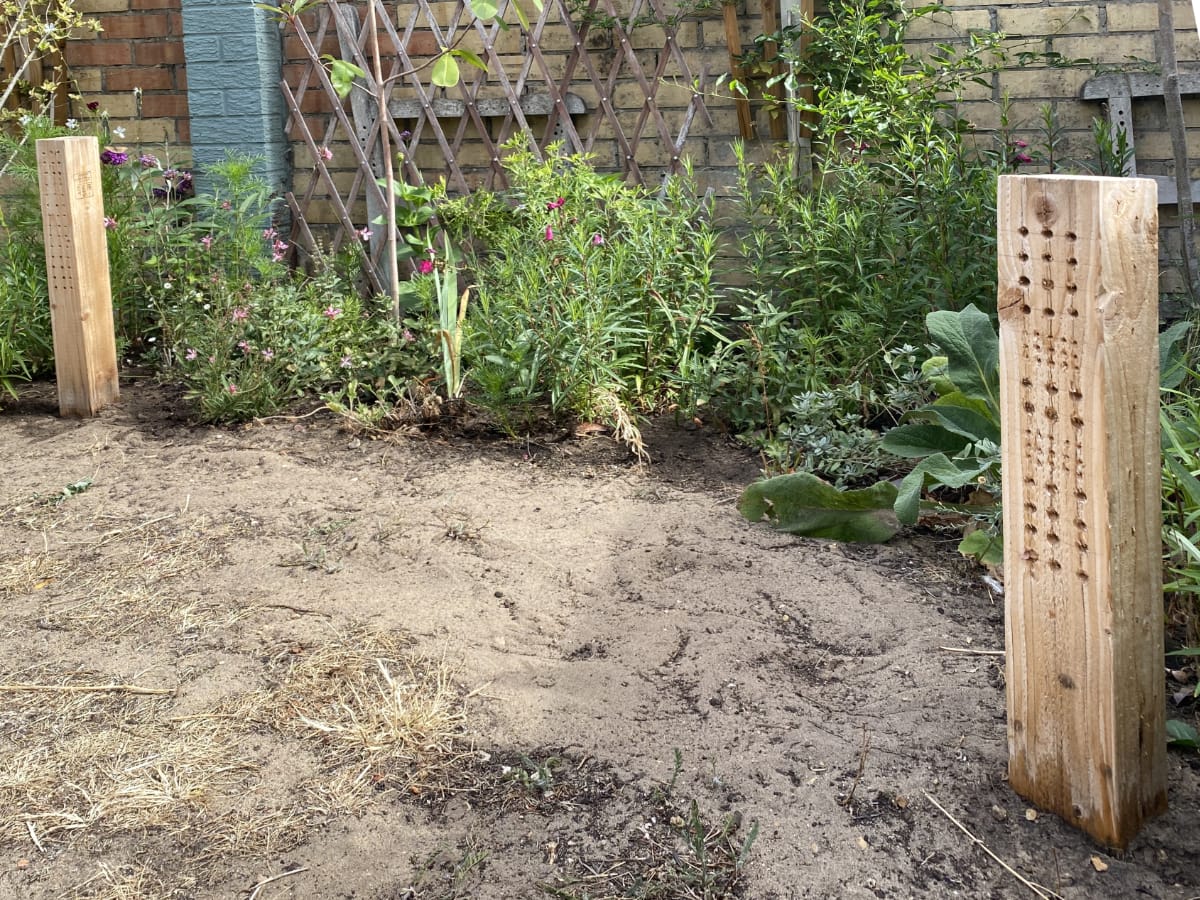
Some of our bee hotels. You can also see how years of constant hot sun as destroyed the lawn
Come late winter, we will carefully remove the bamboo canes that are capped with mud and full of solitary bee eggs. We will store them safely in an unheated shelter until the new generation emerges in spring, while we replace them with fresh, clean hollow canes ready for the next generation.
Down at ground level, our small wildlife pond is home to an abundance of pond snails. To make the water accessible, we placed a broken terracotta pot as a bridge between the earth and water. This allows any critters to get out of the water. Our local Song Thrush has taken full advantage of this setup, using the flat terracotta surfaces as an anvil to smash open snail shells and feast on the contents.
Solitary Wasps, Mimics, and Aphid Hunters
Our DIY bee hotels aren't the only insect hubs in the garden, the surrounding walls and borders are buzzing with incredible predatory insect activity this month.
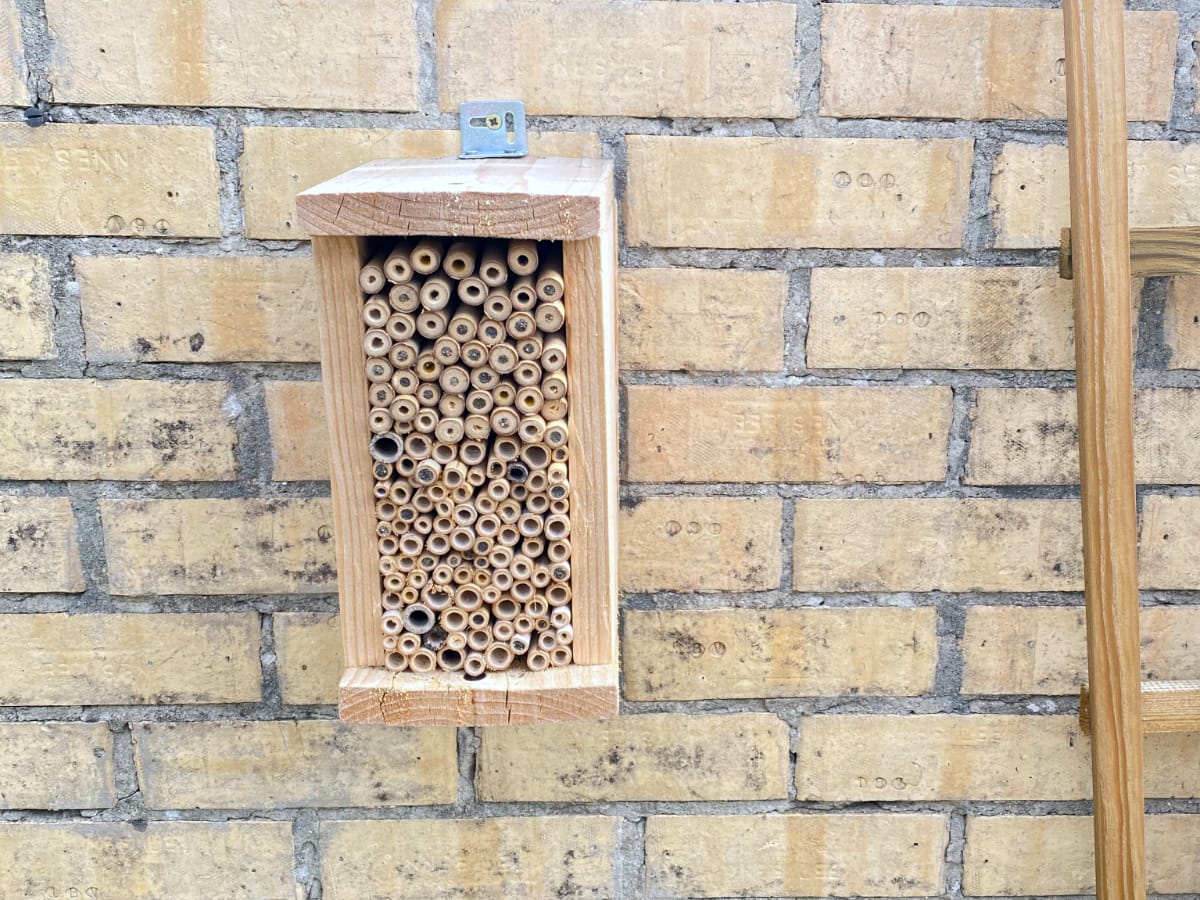
My husband had great fun making this bee hotel
A Red-banded Sand Wasp (Ammophila sabulosa) kept us thoroughly entertained as we watched it tackle a large, bright green caterpillar. The wasp gripped its prey and marched it determinedly up our garden wall before attempting to take flight. However, the caterpillar proved far too heavy; every launch looked like the poor wasp had simply flung itself and its heavy cargo straight off the brickwork! It attempted this heroic lift-off countless times, until I eventually left it to get on with its mission.
- Sunny Days - Red-banded Sand Wasp hunts & paralyses caterpillars.
- Burrow Prepared - Wasp buries prey with a single egg to feed emerging larva.
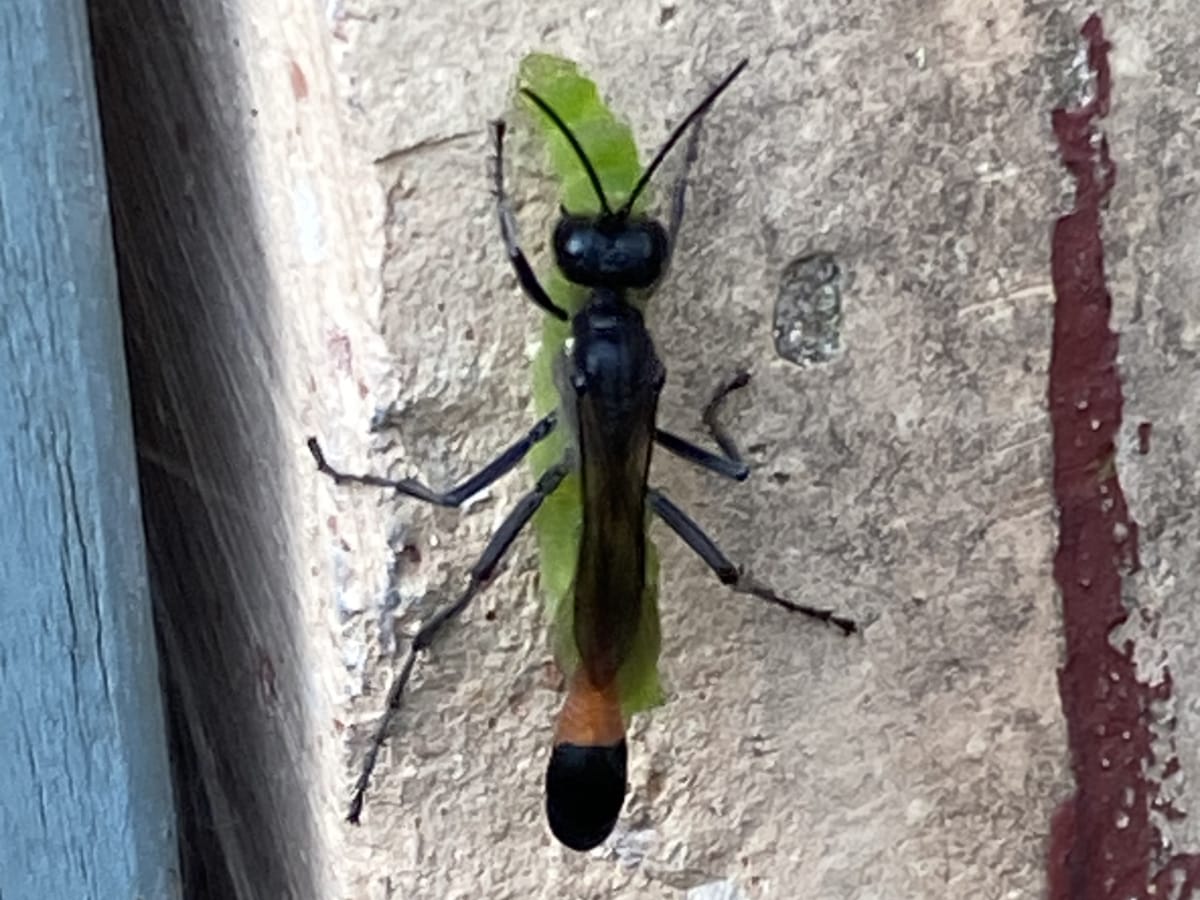
These fascinating solitary wasps hunt mainly on sunny days, of which we have had plenty (now preparing for the 5th heatwave of 2026)! They paralyse caterpillars with a precise sting before dragging them into an underground burrow to lay a single egg on them. If they are feeling opportunistic, they will even steal a paralyzed caterpillar from another female's nest to lay their own egg on it instead.
We are also fortunate to spot several species of Ichneumon wasps. Prior to working in this garden, I had never noticed these extraordinary parasitic wasps before, but they are actually quite common across the UK and can be seen in gardens and the countryside.
While we have an abundance of hoverflies visiting the nectar rich flowers, my absolute favourite is the Hornet Mimic Hoverfly (Volucella zonaria). Sporting dramatic black-and-yellow stripes, it looks remarkably like a formidable hornet, but it is completely harmless. This clever disguise protects it from hungry birds while it searches peacefully for nectar alongside our butterflies and moths.
Down on the "Buddleja 'Black Knight'", a few dedicated ladybirds are working overtime to keep a stubborn aphid infestation under control. This particular shrub, positioned against a fence in late-afternoon shade, always seems to attract a massive aphid attack every spring, with aphids practically outnumbering the leaves! I haven't quite cracked why this specific plant suffers more than the others, but I am very grateful for the natural pest control lending a hand.
Pond Visitors & Wildlife Tracking
After capturing a badger on our nocturnal wildlife cameras, I felt inspired to start sketching again. I have completed a fun, illustrative drawing while I work up to a full, realistic study.
Our night cameras regularly capture local hedgehogs, as well as the distinctive droppings they leave behind. The local deer also pay frequent visits to the front garden, even when they manage to dodge the motion sensors, their fresh footprints in the sandy earth give them away!
Sadly, we frequently see hedgehogs killed on the local roads, as they freeze in front of cars, and I always worry whether it is one of the three regulars who visit our garden. It always surprises me how many passers-by seem completely oblivious to the rich urban wildlife surviving right on their doorstep.
Recently, the cameras picked up several local cats sitting in a circle, staring intently into a mysterious hole that appeared in the ground. It could be an old mole run or a field mouse burrow, there are no telltale tracks in the dry sand, but nothing has emerged yet!
Farewell to the Swifts
Just this week, I noticed that the swifts, who spent early summer screaming low through the garden in tight formation, have officially gathered and departed for warmer climates.
When swifts leave the UK in late summer, they undertake an extraordinary migration, flying thousands of miles south across France and Spain, crossing the Congo basin, and overwintering in sub-Saharan Africa. Their sudden absence is always a poignant marker that late summer is waning.
New Windows and Uninvited Ants
We recently had new windows and doors fitted to the house. To give the installation team clear access, we had to cut back several plants, including the young pyracantha.
Unsurprisingly, the fitters didn't particularly enjoy getting bitten by ants! The stems were covered in greenfly, and the local ant colonies were aggressively defending their honeydew "herds."
The new installation features much slimmer frames and larger panes of glass, offering a stunning, uninterrupted view of the garden wildlife from my desk. While standard advice often favours smaller window openings for thermal efficiency, my experience is that larger glass areas allow the sun beams to stream through those windows to heat the room. Plus, the elimination of drafty frame gaps has significantly blocked out external street noise.
Foxgloves, Figs, and Pot Management
It is time to sow Foxglove (Digitalis purpurea) seeds. The plants that flowered in the garden earlier this summer dropped their seed in July, and I can already see robust rosettes of green leaves forming at ground level for next year's display.
As biennials, foxgloves spend their first year establishing foliage before sending up majestic flower spikes in their second summer. You can sow seeds in pots now and plant them out into borders by November, or hold them over until spring.
While I don't generally grow them in containers, one rogue foxglove seeded itself into a pot alongside a young fig tree. Keeping both hydrated during the heatwave was a challenge! Ultimately, the fig leaves were stripped by caterpillars and the heat caused the figs to ripen prematurely into soft, tasteless fruit, so I prioritized saving the foxglove!
I am steadily planting out my remaining potted plants directly into the garden beds. During a summer heatwave, watering pots with a watering can daily is a massive drain on time and water resources. Once established in our sandy ground, plants require far less intervention. As the patio clears, Mexican fleabane (Erigeron karvinskianus) is already happily filling the empty spaces between the block paving stones.
Looking Ahead to Late August
As we approach mid-August, the rhythm of the day is subtly shifting. Although daytime temperatures still climb past 30°C, and we may get up to 35-40c this week, the early mornings and late evenings are beginning to bring a cool, welcome breeze.
I am choosing not to introduce any brand-new plants until the heat breaks, preferring to let the garden rest. The Cosmos are growing stronger, our Buddleja cuttings are holding firm, and a second wave of flowers is preparing to burst forth from the Drought-Tolerant Mix.
Autumn seed sales are also starting to pick up. There is no rest for the wicked, between garden checks, I am busy measuring out our harvested, dried seeds and packing them into our home-designed paper packets, ready for autumn sowing!

About the Author & Content Disclaimer
The advice in this post is based on 10+ years of hands-on experience testing seeds in our sandy Suffolk Garden.
While I love sharing my journey and the things I discover, please understand that I am not a certified professional in gardening or wildlife. I ground my content by deep-diving into reliable books and expert resources, but please use my advice only as a guide for your specific garden.
I use and sell the same UK-sourced, wildlife-approved seeds in my own garden that you see throughout this site.
Shop our complete seed range here.
If you notice any inaccuracies or have additional insights to share, please feel free to contact me via this website's contact forms.